When global energy investors assess Canada’s renewable energy landscape, one province consistently stands apart: Alberta. From utility-scale solar and merchant battery energy storage systems (BESS) to independent power producers (IPPs), Alberta offers a rare combination of open market access, strong resource fundamentals, and commercial flexibility. The opportunity is compelling — but it comes with meaningful risk.
Unlike other provinces, Alberta’s blend of deregulation, a deep development pipeline, and willingness to experiment with market design has positioned it as Canada’s most attractive jurisdiction for commercial renewable investment. For investors prepared to manage volatility, the province offers scale and upside unmatched elsewhere in the country.
A Market Built for Competition
Alberta’s defining characteristic is its fully deregulated electricity market — the most liberal in Canada. While most provinces rely on Crown utilities and long-term, government-backed power purchase agreements (PPAs), Alberta operates an energy-only market in which generators sell electricity into an open Power Pool and are paid market-clearing prices.
This structure attracts IPPs seeking direct exposure to wholesale power markets rather than fixed-rate contracts tied to government procurement. For solar and BESS developers, deregulation creates optionality: revenues can increase sharply during periods of price volatility, such as demand spikes or dips in renewable generation.
By contrast, Quebec and British Columbia offer stability but limited upside, with tightly regulated systems dominated by Crown utilities. Ontario sits somewhere in between, yet its partially regulated framework still relies heavily on contracts awarded through the Independent Electricity System Operator (IESO), constraining merchant-style development.
Alberta’s approach favours entrepreneurial developers — and rewards those able to tolerate market risk.
Solar: Resource Quality at Commercial Scale
Resource fundamentals further strengthen Alberta’s appeal. Southern Alberta is among Canada’s sunniest regions, with high solar irradiance translating directly into strong photovoltaic (PV) output and competitive project economics.
The 465 MW Travers Solar Project, completed in 2022, demonstrates the province’s ability to support projects at scale. As Canada’s largest PV installation, it attracted significant international capital, including a US$500 million investment from Copenhagen Infrastructure Partners.
More broadly, Alberta Electric System Operator (AESO) data shows thousands of megawatts of solar capacity approved or under construction. This robust pipeline reflects not only superior resource quality but also investor confidence in Alberta’s development and interconnection processes.
Federal and provincial incentives provide additional support. Natural Resources Canada’s Smart Renewables and Electrification Pathways Program has committed more than $160 million to Alberta solar projects, many paired with battery storage, helping reduce early-stage risk and accelerate deployment.
BESS: Canada’s First True Merchant Storage Market
Alberta differentiates itself most clearly in energy storage. It was the first province to allow BESS operators to earn revenue directly from market participation — including energy arbitrage and ancillary services — without relying on fixed contracts.
As renewable penetration rises, price volatility becomes more frequent, strengthening the business case for storage. Batteries can charge during low-price periods, often when wind and solar output is high, and discharge when prices spike. This volatility-driven model has drawn growing interest from sophisticated investors.
Projects now moving forward reflect that confidence. Northland Power, for example, has secured financing for an 80 MW/160 MWh BESS facility expected to come online in 2026.
Co-located solar-plus-storage portfolios are also gaining momentum. Developers such as Starlight and Westbridge Renewable Energy are advancing multi-gigawatt pipelines, signalling that Alberta’s storage market is evolving from pilot-scale experimentation to institutional-grade deployment.
Grid Access: Transparent, but Increasingly Competitive
A key enabler of Alberta’s renewable build-out is the AESO’s relatively transparent interconnection process. Cluster assessments and staged queues provide developers with greater visibility and predictability — a critical consideration for project financing.
Compared with provinces where grid access can be opaque or slow, Alberta has historically allowed capable developers to move more quickly from concept to construction. That advantage, however, is narrowing. Recent reforms — including capacity constraints for certain large loads and ongoing market redesign initiatives — are reshaping interconnection dynamics and will require careful navigation.
The Risks: Policy Uncertainty and Revenue Volatility
Alberta’s deregulated power market is redefining renewable energy opportunity — and risk. Its strengths also come with clear and material risks. Recent policy uncertainty — including a temporary pause on large renewable approvals and debates over market redesign — has weighed on investor confidence and slowed new project development.
More fundamentally, deregulation exposes projects to revenue volatility. Without long-term PPAs or capacity payments, developers must manage fluctuating pool prices and evolving rules governing market design and ancillary services. Returns can be attractive, but downside risk is real and must be actively managed.
Alberta in Context
A national comparison underscores Alberta’s distinct position:
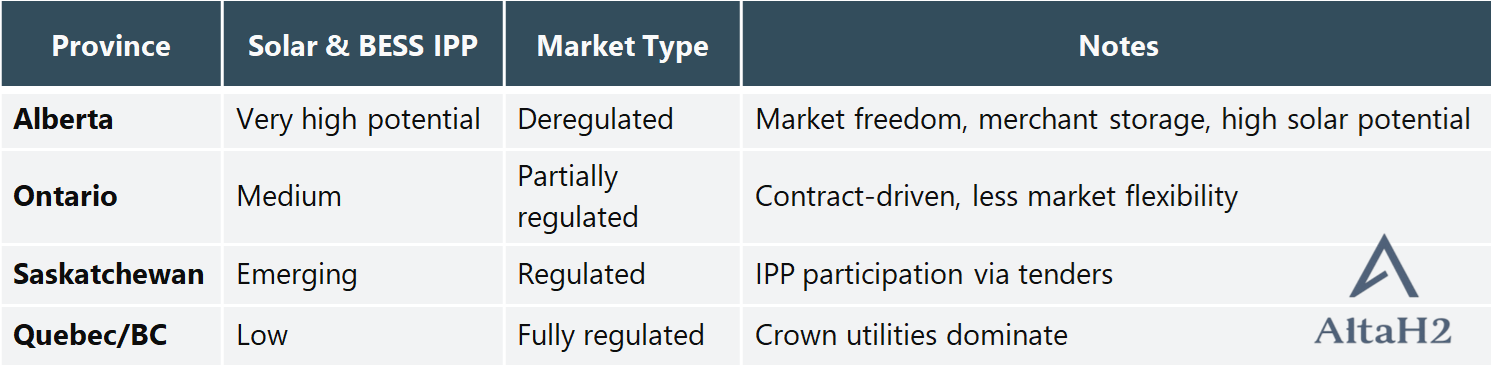
Alberta’s market freedom is both its greatest advantage and its primary constraint. Where other provinces prioritize stability, Alberta prioritizes competition and price signals.
- Alberta: High risk, high reward; fully deregulated market, merchant storage, strong solar resources
- Ontario: Moderate risk; contract-driven with limited merchant flexibility
- Saskatchewan: Emerging market; IPP participation primarily via tenders
- Quebec / British Columbia: Low risk; fully regulated systems with limited IPP access
A Market for the Prepared
Alberta’s combination of strong solar resources, deregulated market design, merchant BESS opportunities, and comparatively transparent grid governance creates an investment environment unlike any other in Canada. For IPPs and storage developers with the expertise and risk tolerance to navigate volatility, the province offers scale and meaningful upside.
Success, however, hinges on disciplined risk management: anticipating policy shifts, adapting to market redesigns, and structuring projects without the safety net of long-term contracts. Those who get it right will find Alberta not only Canada’s most compelling renewable market — but a real-world test case for how liberalized electricity markets can shape the energy transition.